
After the end of the Civil War, six regiments of African American soldiers were established. Among these units was one company stationed at the Vancouver Barracks in Washington in 1899 and 1900. Known as the Buffalo Soldiers, these soldiers served with distinction in the Indian Wars from 1863 into the early 1900s, and in the Spanish-American War in 1898. Their service occurred at a time before the United States Armed Forces was desegregated by presidential order in 1948 — a reminder of the systemic barriers Black servicemembers faced even as they served with honor.
Vancouver’s company of 103 soldiers from the U.S. Army’s 24th Infantry arrived at the barracks when respect for Black soldiers was buoyed by their recent success in the Spanish-American War in Cuba. While in the Northwest, the soldiers participated in military, political, and social activities that introduced many residents of Oregon, Washington, and Idaho to Black servicemembers and raised local awareness of the national policies and practices that beleaguered African Americans.
The regular assignments of garrison duty at an army post included drilling, marching, marksmanship practice, improving the post’s infrastructure, performing maintenance and clerical work, and attending the post school — all vital to maintaining readiness and supporting the post’s mission.
A regional crisis soon called them to arms. Violence had erupted in the Coeur d’Alene mining area in northern Idaho when a mill owned by the Bunker Hill and Sullivan Mining Company was dynamited. The federal government dispatched troops, and in May 1899 Company B — being among the closest soldiers to the conflict — responded to the scene. Along with soldiers from other forts, they imposed martial law and guarded prisoners and rail lines in what became one of the major labor-capital conflicts of the twentieth century.
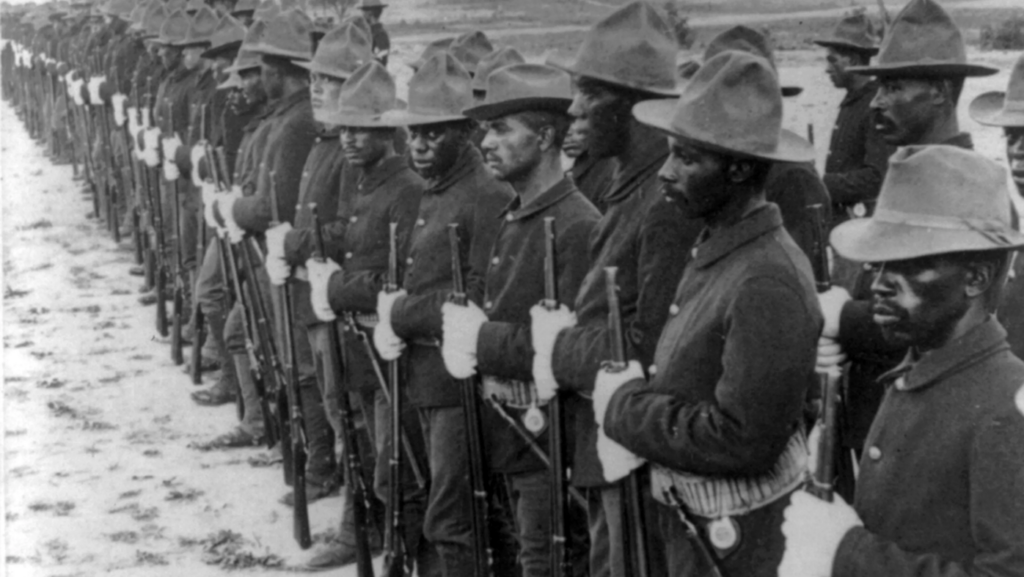
During their leisure time, the soldiers organized dances, parties, and baseball games. The Portland New Age, a Black-owned newspaper, reported on their involvement in social activities, including a wedding in Vancouver where “quite a number of friends from Portland attended.” The company’s baseball team, called the Hard Hitters and the Brownies in local newspapers, played several games, including some against white teams.
Company B’s duty at Vancouver Barracks ended on May 17, 1900, when they departed for Fort Wright near Spokane, Washington. Within months, on October 16, they had been transferred to the Presidio in San Francisco, and then on to duty in the Philippine Islands.
Black History Month also provides an opportunity to reflect on the broader scope of Black Americans’ military service. Between 370,000 and 400,000 African American service members served in Europe during World War I, at a time when racial violence was still rampant in the United States. According to Library of Congress historian Ryan Reft, Black soldiers were often required, especially in the South, to “go out almost dressed as labor gangs, and not in uniform, because the military was afraid of offending white … sensibilities,” he said. “It’s literally dangerous to wear a uniform in some places,” he continued. But overseas, they could wear it with pride and serve as Americans without worrying about being targeted negatively.
As we recognize Black History Month, ODVA encourages all Oregonians to learn more about the remarkable history of Black service members like the Buffalo Soldiers — whose commitment helped shape our nation even in the face of adversity.
Views: 710